
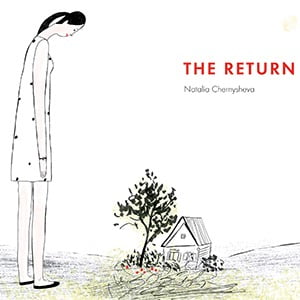
In this picturebook, a woman returns home from her exciting life in the city to visit her grandmother, but finds that she is a giant compared to her, representing her sense of maturity and new-found independence. However, as she reconnects with her … [Llegeix més...]
Ant [Formiga]

Es tracta d’una pel·lícula de Film Bilder, l’estudi que va crear Head Up. Aquesta pel·lícula, que forma part de la sèrie Animanimals de Julia Ocker, mostra la vida sistemàtica i col·lectiva d’una colònia de formigues. La precisió militar de les … [Llegeix més...]
Alike [Igual]

Aquest conte sobre un pare i el seu fill tracta de l'apatia i el desànim causat per l'excés de treball i l'aïllament. Un pare està abatut a la feina mentre el seu fill, encara jove, és optimista sobre el fet d'anar a l'escola. L'estat d'ànim alegre … [Llegeix més...]
Bon Voyage [Bon Viatge]

La crua ironia del títol d'aquest curtmetratge demostra el dur tractament que dóna al difícil i important tema de la migració forçada. La història comença com una animació tradicional, representant a un grup de refugiats mitjançant traços simples, … [Llegeix més...]
Tierenduin [Zoo de Qui?]

This look-and-search book challenges the reader to see things differently. The mouth of a tiger hides the face of a sloth; the teeth of a snake become the icebergs upon which a polar bear roams. The book asks us to reconsider what we expect to see … [Llegeix més...]
Che Capolavoro! [Quina obra d’ Art]

This picturebook takes canonical examples of classic and modern art to explore the universality of artwork in everyday life. The main character is surrounded by signifiers of art and culture - from Banksy to Salvador Dali, from Einstein to the Eiffel … [Llegeix més...]
Naar de Markt [Al Mercat]

Aquest llibre és un retrat senzill d’una mare i una filla que van al seu mercat local. El lector s’assabenta d’una sèrie d’experiències, inclòs un conjunt divers de menjars i objectes, que venen una col·lecció de comerciants multiculturals i … [Llegeix més...]
Ką padarė žirklės? [Què Feien les Tisores]

The majority of wordless picturebooks produced in Europe are produced in Northern and Western European countries. However, the oldest example of the form used in this corpus is a Lithuanian wordless picturebook originally published in 1961. It has … [Llegeix més...]
Verrückte Welt [El Món de Cap per Avall]

German artist ATAK presents a carnivalesque theme of power negotiation in this representation of an upside down world. The banker begs on the street corner while the punk hands over spare change; the mouse chases the cat; a horse rides a jockey; a … [Llegeix més...]
